


Metal Angle Supports
A metal angle supports is a fastener designed to secure and connect two pieces or objects. They are commonly used to support shelves, stabilize equipment, fasten uprights, or provide decorative accents.
Xiamen Jinghe Natural New Materials Co., Ltd has focused on top-quality hardware products like stainless steel products, metal products, galvanized products, customized by sample or drawing, etc. all over 20 years in China. We started as a small operation, but now have become one of the leading suppliers in the metal products industry in China.Today, we have varied products such as ground screws, brackets, Solar Carport products, bridges, C channel steels, manufacturing metal products, and also for buyers customized any metal products.
Why Choose Us
Wide Product Range
Today, we have varied products such as ground screws, brackets, Solar Carport products, bridges, C channel steels, manufacturing metal products, and also for buyers customized any metal products.
Quality Assurance
The quality of our products is undoubtedly guaranteed. They meet the highest quality requirements as stipulated in ISO9001, ISO14000:14001 SGS guidelines, and our stringent quality control system.
Wide Range of Applications
Our products are applicable to many situations, for example, solar energy foundations, wooden chalets, integrated houses, container houses, tent hotels, light steel structures, wooden walkways, water trestles, Pillar foundations, handrails/fences, tower foundations, recreational facilities, etc.
Broad Market
We have customers from both the domestic market and the overseas market. Our main sales market is North America as well as Southern Europe, which respectively take up 25.00% and 15.00%.

Items: Ground foundation screws
Material: Q235 steel
Length: 500mm-2000mm or customized
Surface: Hot dip galvanized
Packing :①For small parts: Plastic bag, box, wooden pallet, crate
Packing :②For Big Parts: Steel pallet, wooden pallet, crate
Lead Time: 3-10 working days

Ground screws, also known as helical piles or screw piles, are innovative foundation systems that provide a secure and stable base for various structures. They consist of a steel shaft with helical plates attached to them. These plates allow the ground screws to be easily rotated into the ground using machinery.

Items: Ground screw anchor footings
Material: Q235 steel
Length: 500mm-2000mm or customized
Surface: Hot dip galvanized
Packing :①For small parts: Plastic bag, box, wooden pallet, crate
Packing :②For Big Parts: Steel pallet, wooden pallet, crate

Items: Ground foundation screws
Material: Q235 steel
Length: 500mm-2000mm or customized
Surface: Hot dip galvanized
Packing :①For small parts: Plastic bag, box, wooden pallet, crate
Packing :②For Big Parts: Steel pallet, wooden pallet, crate

Ground Screw Foundation for House
Items: Ground screw foundation for house
Material: Q235 steel
Length: 500mm-2000mm or customized
Surface: Hot dip galvanized
Packing :①For small parts: Plastic bag, box, wooden pallet, crate
Packing :②For Big Parts: Steel pallet, wooden pallet, crate

Items: Steel screw piles price
Material: Q235 steel
Length: 500mm-2000mm or customized
Surface: Hot dip galvanized
Packing :①For small parts: Plastic bag, box, wooden pallet, crate
Packing :②For Big Parts: Steel pallet, wooden pallet, crate

Items: Solar Bracket Hook
Material: Stainless Steel: SS201, SS304, SS316; Carbon Steel: Gr A2; Aluminum
Finishing: Plain, Sand Blasting
Sizes: Production according to customer drawings
Production Process: Cold Forging, Machining and CNC, Stamping, Welding

Items: Metal Angle Supports
Material: Steel, stainless steel, aluminum and so on
Sizes: Production according to customer drawings
Structure: 90 degree L shaped
Thickness: 2-4mm
Color: Original color or as customized
Lead Time: 10-20 working days
Payment:TT 100% or 30% deposit, the balance before shipment

Items: Solar panel mounting stand
Material: Steel, stainless steel, aluminum and so on
Sizes: Production according to customer drawings
Wind Load: 60m/s
Snow Load: 1.4kN/㎡, 1.4KN/m2
Installation Site: Open Field/Ground
Color: Original color or as customized
What is Metal Angle Supports
A metal angle supports is a fastener designed to secure and connect two pieces or objects. They are commonly used to support shelves, stabilize equipment, fasten uprights, or provide decorative accents. Metal brackets can come with or without holes and may be threaded to accommodate screws. They are essential hardware components for holding items together, enabling doors to function, and can include hasps for locking enclosures.
Versatile
Metal angle brackets have many applications. They provide support for doors and ceilings. They are used as frames or supports for structural elements. They are also used as decorative elements for doors, furniture and other structures.
Easy to use
When dealing with angled areas, such as angled ceilings, it is easier to use metal angle brackets than screws. They are easy to install. You don't need to use as much on an angled area as you would with screws. You also don't need a lot of installation tools or any expertise.
Requires minimal maintenance
Most, if not all, metal angle brackets are coated to prevent them from rusting and corroding. You can even paint them, which won't affect their durability. They are designed to last a long time, which is why they are better than screws in some situations.
Available in a variety of styles and sizes
With metal angle brackets, you are not limited by a specific style or size. Decorative metal angle brackets especially come in different designs to match your decor.
Sustainable
Recycling or reusing metal angle brackets is easy. They are sustainable and environmentally friendly because you can remelt them into other steel products. This eliminates waste and reduces the need to mine new materials.
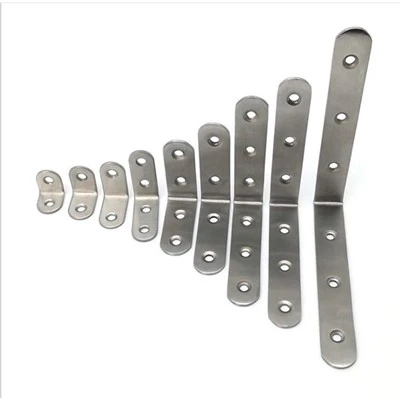
Right Angle Brackets
Simple right angle brackets that have a 90 degree angle. There is no lip on these brackets, so they're able to fit a range of shelf depths. Our angle brackets designated for shelving are 3/16″ thick, which is plenty strong for most shelving.
Hook Shelf Brackets
A right angle bracket that has the mounting side of the bracket above where a shelf rest. This design is also known as a J bracket. These brackets have a lip, so the depth of the shelf has to match the depth of the bracket.
Lip Shelf Brackets
A right angle bracket that has the mounting side of the bracket below where the shelf rests. A great bracket design for larger items, as the bracket mounting side is away from objects set on the shelf. Great brackets for a kitchen to stack cups, glasses, and plates.
Application of Metal Angle Supports
DIY Projects
Metal Angle Supports are helpful for people who enjoy DIY projects and hobbies. These brackets are essential because they can support and adjust to different angles needed for various projects. They can be used for building workbenches, storage racks, installing solar panels, or creating outdoor structures. These flexible brackets can adapt to specific angle requirements, making the project more functional and attractive.
Construction
Metal Angle Supports are commonly used in construction projects requiring precise angle adjustments. They provide a convenient solution for connecting beams, joists, posts, or other structural components at varying angles, ensuring stability and structural integrity. These brackets are handy in projects such as roof trusses, staircases, decks, or any application where precise angles are crucial.
Furniture and Shelving
Due to their versatility and adaptability, Metal Angle Supports have gained popularity in the furniture industry. They allow for the creation of custom shelving units, bookcases, cabinets, or other furniture pieces where the angle of the shelves or supporting structures can be adjusted to accommodate different items or design preferences. These brackets offer the flexibility to modify the arrangement as needed, making them ideal for organizing spaces efficiently.
Steel
Steel is the most used material for metal angles as it is strong, durable, and affordable. It is typically available in a variety of grades and alloys. The choice of steel grade will depend on the intended use and the desired properties, such as strength, durability, and resistance to corrosion.
Aluminium
Aluminium is a lightweight and corrosion-resistant material often used for metal angles. It is commonly used in construction and engineering applications, as well as in DIY projects.
Stainless Steel
Stainless steel is a strong and durable material that is resistant to corrosion and rust. It is often used in applications where appearance is key, such as furniture and interior design. In addition, it is often used in environments where exposure to moisture or corrosive substances is a concern.
Metal Angle Supports Components
Base Plate
The base plate is the flat or curved part of the bracket that attaches it to a surface. Positioned at the bottom of the bracket, it provides stability and a solid connection. Base plates typically feature holes for screws, bolts, or other fasteners, although some come without pre-drilled holes to allow for custom placement.
Support Arm
The support arm extends from the base plate to hold an object or structural component in place. The design of the support arm varies depending on the application; it can be thick, heavy, and positioned at different angles. Support arms are available in various sizes, configurations, and metals to suit different needs.
Mounting Holes
Mounting holes are stamped, drilled, or cut into both the support arm and base plate to secure the bracket to a surface with screws, bolts, or other fasteners. The size, shape, and placement of these holes depend on the bracket's location and intended use.
Bracing
Bracing is used to reinforce the support arms or crossbars of a metal bracket, providing additional support and stability. Metal brackets often bear varying loads, such as bending, tension, compression, or torsion. Bracing ensures that the bracket can withstand these forces and maintain its structural integrity.
How to Choose Metal Angle Supports
Load capacity
Load capacity refers to the maximum weight a metal angle supports can safely support without failing. This capacity is influenced by the bracket's design, size, structure, and material. Popular metal angle supports made from steel, stainless steel, and aluminum can support up to 500 lbs. These materials are known for their durability, longevity, and reliability.
Environmental concerns
The environment where a bracket is used is crucial, as corrosive and harsh conditions can significantly reduce its lifespan. Factors like moisture, heat, and exposure to the elements affect performance. Brackets intended for outdoor use are typically made from rust- and corrosion-resistant metals.
Cost
The cost of metal angle supports varies based on material, size, load capacity, and intended use. While cost is an important consideration, brackets should be chosen based on functionality to avoid the higher costs associated with potential failures. Investing in higher-quality brackets may result in long-term savings due to their extended durability.
Compatibility
Ensuring compatibility with other system components is essential. For instance, brackets supporting pipes or conduits must match the size and shape of the pipe. Additionally, brackets used with other hardware or fasteners should fit seamlessly with those components.
Process of Metal Angle Supports
Design and measurement
Begin by determining the desired size and shape of your metal angle supports. This initial design phase is crucial, as it sets the foundation for your project. Once you have a clear idea of the dimensions and style, measure and mark the metal sheet accordingly. Use a measuring tape to ensure accuracy, and a marker to clearly outline the shapes on the metal, which will guide you during the cutting process. This careful preparation helps achieve precise and well-fitting metal angle supports.
Cutting the metal
Once you have marked the metal sheet with your desired shapes, it's time to cut. Select an appropriate cutting tool, such as metal shears, a jigsaw, or an angle grinder, depending on the metal's thickness. Secure the sheet on a stable work surface, and ensure you wear safety gear, including gloves and safety glasses. Carefully follow the marked lines while cutting, applying steady pressure for clean, straight cuts. After cutting, inspect the edges and use a file to smooth any rough spots for safety and a professional finish.
Bending the metal
To bend the cut metal into the desired metal angle supports shape, use a vise, pliers, or a metal brake. For simple bends, pliers can be effective, while a vise provides stability for more pronounced angles. If your design requires complex bends or precise angles, a metal brake is recommended, as it allows for greater accuracy and control. Make sure to apply even pressure during the bending process to avoid warping the metal. Once bent, check that the shape aligns with your design specifications before moving on to the next step.
Drilling holes
Begin by marking the locations for the screw holes on the metal angle supports, ensuring they are evenly spaced and aligned with your intended mounting points. Use a ruler or measuring tape for accuracy, and clearly mark each spot with a marker. Once you have your markings, select the appropriate drill bits for the size of screws you will be using. Carefully drill at each marked location, applying steady pressure to create clean holes without damaging the metal. Be sure to wear safety glasses during this process to protect your eyes from metal shavings.
Finishing touches
For the finishing touches, begin by cleaning the edges of the metal angle supports to remove any sharp burrs or rough spots, which enhances both safety and aesthetics. Use a file or a deburring tool to smooth out these edges, ensuring a polished look that prevents potential injuries. After deburring, consider applying a protective coating, such as paint or a clear coat, to shield the metal from moisture and prevent rust. This added layer not only enhances durability but also allows you to customize the appearance of your metal angle supports to match your decor or project needs.
Our Factory


FAQ
Hot Tags: metal angle supports, China metal angle supports manufacturers, suppliers, factory, Perforated Metal Cable Tray, Ground Screw Foundation for House, Seismic Support for Cable Tray, Wire Mesh Cable Tray, Seismic Brackets, Ground Screw Piles


Send Inquiry
