


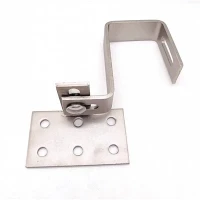
Pv Support Bracket
Items: pv support bracket
Material: Steel, stainless steel, aluminum and so on
Sizes: Production according to customer drawings
Wind Load: 60M/s
Snow Load: up to 1.5KN/m2
Warranty: 10 Years
Surface Treatment: hot-dip Galvanized
Application: PV Solar Panel Installation
Installation Site: Open Field
Color: As customized
Tilt Angle: up to 45 degree
Lead Time: 10-20 working days
Payment:TT 100% or 30% deposit, the balance before shipment
What is a Pv Support Bracket
PV Support Bracket, a structural device designed for securing and positioning solar panels, optimizes sunlight absorption by enabling optimal tilt angles on rooftops or ground installations. Constructed with corrosion-resistant materials like aluminum alloy or stainless steel, it ensures durability and reliability in outdoor conditions.
Product Characteristics
Durable Material
The PV Support Bracket is made up of durable and high-quality material which is capable of withstanding harsh weather conditions.
Adjustable Height
The PV Support Bracket has an adjustable height feature that allows it to be customized according to the height of the solar panels.
Versatile
The PV Support Bracket can be used for both commercial and residential purposes. It is suitable for different types of roofs including flat, metal, and tile roofs.
Environment-friendly
The PV Support Bracket is an environmentally friendly option for mounting solar panels. It reduces the carbon footprint and promotes sustainable energy.
Easy Installation
The PV Support Bracket can be easily installed by anyone who has basic knowledge of tools required for installation. It comes with an easy to follow installation manual that makes the process easier.


Packing And Transportation
Here are five packaging and transportation methods for PV support brackets.
Cardboard boxes
One of the most common packaging methods for PV support brackets is cardboard boxes. These boxes are typically made from strong corrugated cardboard and can be designed to fit the specific dimensions of the brackets.
Pallets
Another popular way to transport PV support brackets is by placing them on pallets. Pallets are made from sturdy materials like wood or plastic and can hold several brackets at once.
Bulk packaging
For large solar panel installations, PV support brackets may be packaged in bulk. This method can be more cost-effective and efficient for larger installations.
Flat packing
Some PV support brackets can be flat-packed for ease of transportation.
Container shipping
For international shipments of PV support brackets, it is common to use container shipping. The brackets are loaded onto shipping containers and transported by sea or air. The containers can be customized to fit the exact dimensions of the brackets and can be secured with tie-downs to prevent movement during transport.

Installation Guide for Pv Support Bracketd
Preparations
Before starting the installation of the PV support bracket, ensure that all necessary tools and materials are ready. These typically include: a PV support bracket kit, drill bits, screwdrivers, wrenches, rulers or tape measures, marking pens, spirit levels, safety glasses, and gloves. Additionally, make sure to read and understand all safety warnings and guidelines in the product manual.
Selecting the Installation Site
Choose a location that is structurally sound and capable of supporting the weight of the solar panels. Ensure that this spot is not shaded to maximize sunlight exposure. Also, consider wind direction and surrounding environment to avoid potential obstructions that could affect the performance of the solar panels.
Marking the Installation Points
Use a ruler and marking pen to accurately mark the installation points on the predetermined location. Make sure all marks are level and comply with the requirements of the design drawings. If needed, use a spirit level to verify the accuracy of the markings.
Drilling and Securing Expansion Bolts
At the marked points, use an appropriately sized drill bit to bore holes in the wall or roof. The depth should be determined according to the specifications of the expansion bolts, usually between 8-10 centimeters deep. Then insert the expansion bolts into the holes and tighten them with a wrench to ensure they are secure.
Installing the PV Support Bracket
Align the PV support bracket with the expansion bolts and fix it using a screwdriver and wrench. During this process, ensure the bracket's levelness and perpendicularity to avoid affecting the installation quality and power generation efficiency of the solar panels.
Checking and Adjusting
After completing the installation, carefully check each connection point for reliability and firmness, ensuring there are no loose parts. Also, recheck the bracket's levelness and perpendicularity with a spirit level and make adjustments if necessary.
Cleaning Up the Site
Finally, clean up the installation site by properly storing all tools and leftover materials, maintaining a tidy work area.
Maintenance Guide for Pv Support Bracketd
Regular Inspection
To ensure the long-term stability and safety of the PV support bracket, perform a comprehensive visual inspection every quarter. Check the tightness of the bracket, examine if there is any peeling or corrosion on the surface coating, and verify that all connections are secure.
Cleaning Maintenance
Due to external environmental factors, dust, leaves, or other debris may accumulate on the PV support bracket. These contaminants not only reduce the efficiency of solar panels but can also accelerate metal parts' corrosion. Therefore, it is recommended to clean the surface dirt with a soft cloth or sponge at least once every six months and rinse with water. Avoid using any chemical cleaners as they may damage the bracket material.
Rust Prevention Treatment
If slight rust is found, use sandpaper to gently remove the rust, then apply a layer of anti-rust paint. For severely corroded parts, replacing damaged components may be necessary. Choose appropriate anti-rust materials according to the recommendations in the product manual.
Hardware Inspection
Regularly check all bolts, nuts, and other fasteners to ensure they are not loose. If damaged or severely worn parts are discovered, replace them promptly. Maintaining proper torque values is crucial to prevent over-tightening or under-tightening.
Structural Integrity Assessment
Conduct a structural integrity assessment at least once a year to ensure the support bracket has not deformed or sustained damage. This includes checking the bracket's levelness and verticality, as well as the stability of all load-bearing parts.
Record Keeping and Tracking
Maintain a detailed maintenance log, recording the date, content, and results of each inspection and maintenance activity. This helps track the health status of the equipment and provides useful historical information when issues arise.
Frequently Asked Questions
1. Can the PV support bracket be installed on a sloped roof?
PV installations on rooftops are fast becoming an increasingly popular solution for homeowners worldwide. Pitched roofs with tiles on houses or metal sheet roofing on warehouses each need a suitable mounting system to install PV modules safely and efficiently.
2. Are there different sizes available for the PV support bracket?
Bracket end clamp contains 4 sizes for choice, which are 30mm/1.2in, 35mm/1.4in, 40mm/1.6in or 45mm/1.8in (with or without hexagonal spanner), so there are 8 sets to choose from.
3. What materials are used in the construction of the PV support bracket?
The solar photovoltaic bracket is a special bracket designed for placing, installing and fixing solar panels in the solar photovoltaic power generation system. The general materials are aluminium alloy, carbon steel and stainless steel.
4. Does the PV support bracket come with a warranty?
It can be divided into two types according to the material, the aluminum alloy and steel. Generally both of the two types of bracket have a minimum warranty of 25 years, but different material and production process come with a different service life.
5. Is professional installation recommended for the PV support bracket, or can it be a DIY project?
We recommend you do not attempt a DIY solar energy system installation, as the risks involved to get it right, outweigh the rewards.
6. Is there a difference in performance between aluminum and stainless steel PV support brackets?
In terms of strength analysis, the strength of aluminum alloy solar bracket is weaker than that of stainless steel. Therefore, it is recommended to use steel brackets for strength in areas with high wind resistance requirements or in practical applications.
7. Are there any special considerations for mounting the PV support bracket on a tile roof?
Tile roof PV mounts must be compatible with the specific type of tiles on your roof, whether they are clay, concrete, or slate. Different tile shapes and materials require different mounting solutions to ensure secure attachment without causing damage to the tiles.
8. Are there any specific installation angles recommended for maximizing solar exposure with the PV support bracket?
Angles matter less than the direction. According to the DOE, south-facing solar panels perform best when they're tilted between 15 and 40 degrees. Residential rooftops in the US seem to be most commonly tilted between 18 and 34 degrees-pretty much ideal.
Hot Tags: pv support bracket, China pv support bracket manufacturers, suppliers, factory, Stamped Metal Brackets, Metal Angle Supports, Seismic Brackets, Solar Panel Mounting Stand, Sheet Metal Bracket, Seismic Cable Bracing


Send Inquiry
